

Robots are one of the biggest trends in the world today. More companies want to show humanoid robots at exhibitions in the United States. However, the U.S. rules for robots changed in July 2026, and they are still changing. If you plan to exhibit a robot in the U.S., please read this before you ship.
Who makes the rules?
Two U.S. government agencies are involved:
- The Federal Communications Commission (FCC) controls electronic products that send or receive radio signals, such as Wi-Fi or Bluetooth. Almost every modern robot has these.
- U.S. Customs and Border Protection (CBP) checks goods when they arrive in the U.S. CBP can refuse entry to a device that does not meet FCC rules.
What changed?
On 28 July 2026, the FCC added "foreign-produced advanced robotic devices" to its Covered List. The Covered List is a list of equipment that the U.S. government considers a risk to national security.
This rule is not only for humanoid robots. It also includes four-legged robots, wheeled robots, and even some robot vacuum cleaners and lawn mowers.
Is my robot covered?
Your robot is covered if it is produced outside the U.S. and it meets all of these conditions:
- It can move on the ground (for example, walk, roll, or move around objects).
- It can work at a distance from the person controlling it.
- It weighs more than 4.4 lb (about 2 kg), including its charging dock or base station.
- It has a sensor that detects its surroundings, such as a camera or LiDAR.
- It can connect to a network (cable, Wi-Fi, Bluetooth, mobile or satellite) at 200 kbps or faster.
- It has software, including AI, that controls how it moves, senses, collects data, or is controlled remotely.
"Produced outside the U.S." depends on where the product and its parts are made. The nationality of the company does not matter. Some products are excluded, such as drones and certain medical robots.
What does this mean for importing?
The rule works like a partial ban:
- New models cannot get FCC approval (called "equipment authorization"). Without this approval, a robot cannot be imported, sold or marketed in the U.S. in the normal way.
- Models that already had FCC approval before 28 July 2026 can still be imported, sold, marketed and exhibited. However, the FCC can cancel an approval later, and it has already done this once.
- Owners can keep using robots they already have. Some software and firmware updates are allowed under a special FCC waiver. Hardware changes are not allowed.
- Manufacturers can apply for a "Conditional Approval" from the U.S. Department of War. If a model receives it, the restriction no longer applies to that model. The first robots received Conditional Approval in September 2026.
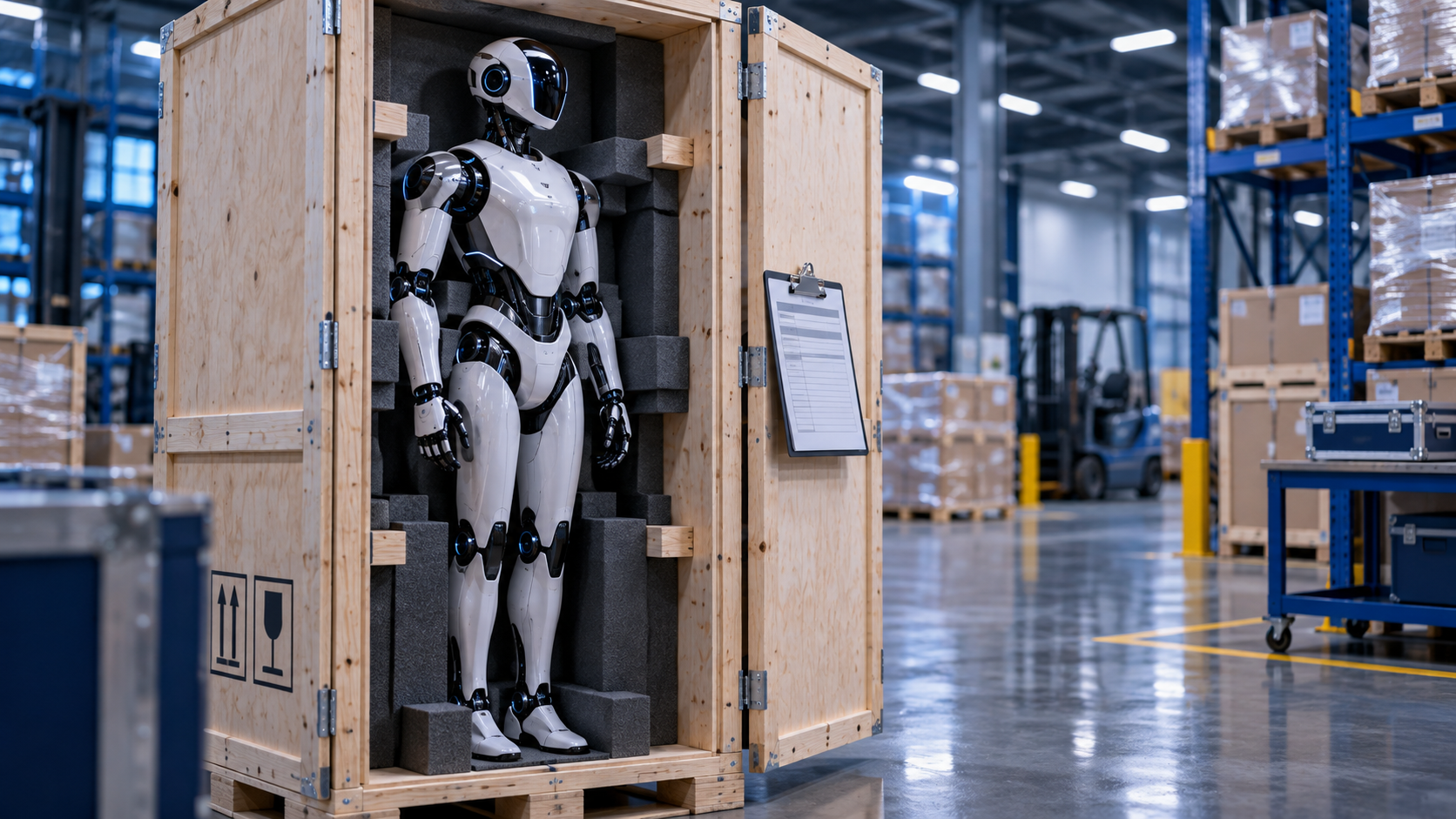
Can I bring a new, unapproved model to a trade show?
This is the hardest question, and the answer is not yet fully clear.
The current FCC rules for new, unapproved models are for testing and development, not for trade show display. The FCC has not made rules specifically for trade shows.
It is best to discuss this with TWI and investigate your options before you finalize your plans to exhibit your robot.
Before you ship, check:
- Does my robot meet the definition above?
- Does this exact model already have FCC approval? You can search the FCC ID database to check.
- Has this model received Conditional Approval?
- What will I do with the robot in the U.S.: display it only, operate it, or test it?
Talk to TWI early
If you are planning to ship a humanoid robot or any other mobile robot to a U.S. trade show, please contact TWI as early as possible. We review each shipment carefully to decide whether your robot can be shipped and how it can be used at the show.